
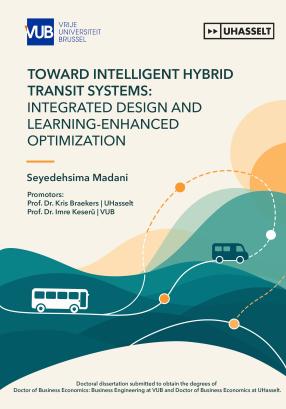
On 9 October 2026, Seyedehsima Madani successfully defended her PhD at the Vrije Universiteit Brussel (VUB), as part of a joint doctoral programme with Hasselt University (UHasselt), with her dissertation entitled “Toward Intelligent Hybrid Transit Systems: Integrated Design and Learning-Enhanced Optimization.” Her research focuses on developing integrated planning and optimization approaches for hybrid public transportation systems, combining fixed-route transit with demand-responsive services to improve accessibility, operational efficiency, and resource utilization.
Sima holds a Master’s degree in Industrial Engineering from the Iran University of Science and Technology and a Bachelor’s degree in Industrial Engineering from Isfahan University of Technology, Iran. Before joining VUB, she gained extensive professional experience in business transformation, strategic planning, and performance management across different industries. Her academic and professional background combines operations research, mathematical optimization, machine learning, and strategic decision-making.
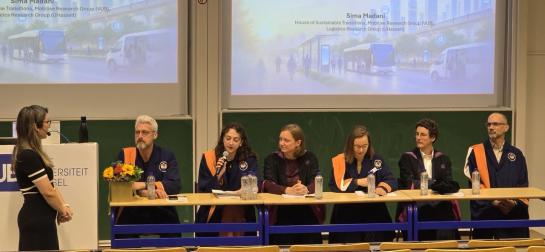
Her PhD research was conducted under the supervision of Prof. Imre Keserü (VUB) and Prof. Kris Braekers (UHasselt), within the Mobilise Research Group at VUB and the Logistics Research Group at UHasselt. Her work contributes to the development of intelligent and sustainable mobility solutions through advanced optimization and machine learning techniques.
In her thesis, Sima investigates how fixed-route transit (FRT) and demand-responsive transit (DRT) services can be jointly designed rather than planned independently. She first conducts a systematic literature review to identify existing integration approaches and research gaps. Building on these findings, she develops a bi-level optimization framework that simultaneously considers fixed-route network design, service frequencies, passenger assignment, and demand-responsive vehicle routing and scheduling. Finally, she integrates machine learning techniques into the optimization process to reduce computational complexity and improve the scalability of the proposed framework.
Her key findings highlight that:
- A systematic review of 83 studies identifies key research gaps, particularly the lack of integrated approaches for jointly designing fixed-route and demand-responsive transit systems.
- Joint optimization of FRT and DRT reduces total fleet requirements by approximately 11% compared to sequential planning, while maintaining comparable service coverage and passenger travel times.
- Integrated planning enables more efficient resource allocation by adapting the balance between fixed-route and demand-responsive services to different travel demand patterns.
- Machine learning surrogate models, particularly XGBoost, significantly accelerate the optimization process, achieving up to 18 times faster computation.
- Combining machine learning with periodic optimization evaluations improves reliability while reducing computational time by 4–6 times, with minimal impact on solution quality.
- The proposed framework provides a foundation for intelligent decision-support tools, helping transport authorities design more accessible, efficient, and sustainable public transportation systems.